Load Cell vs. Hall-Effect Pedals: Which Actually Makes You Faster?
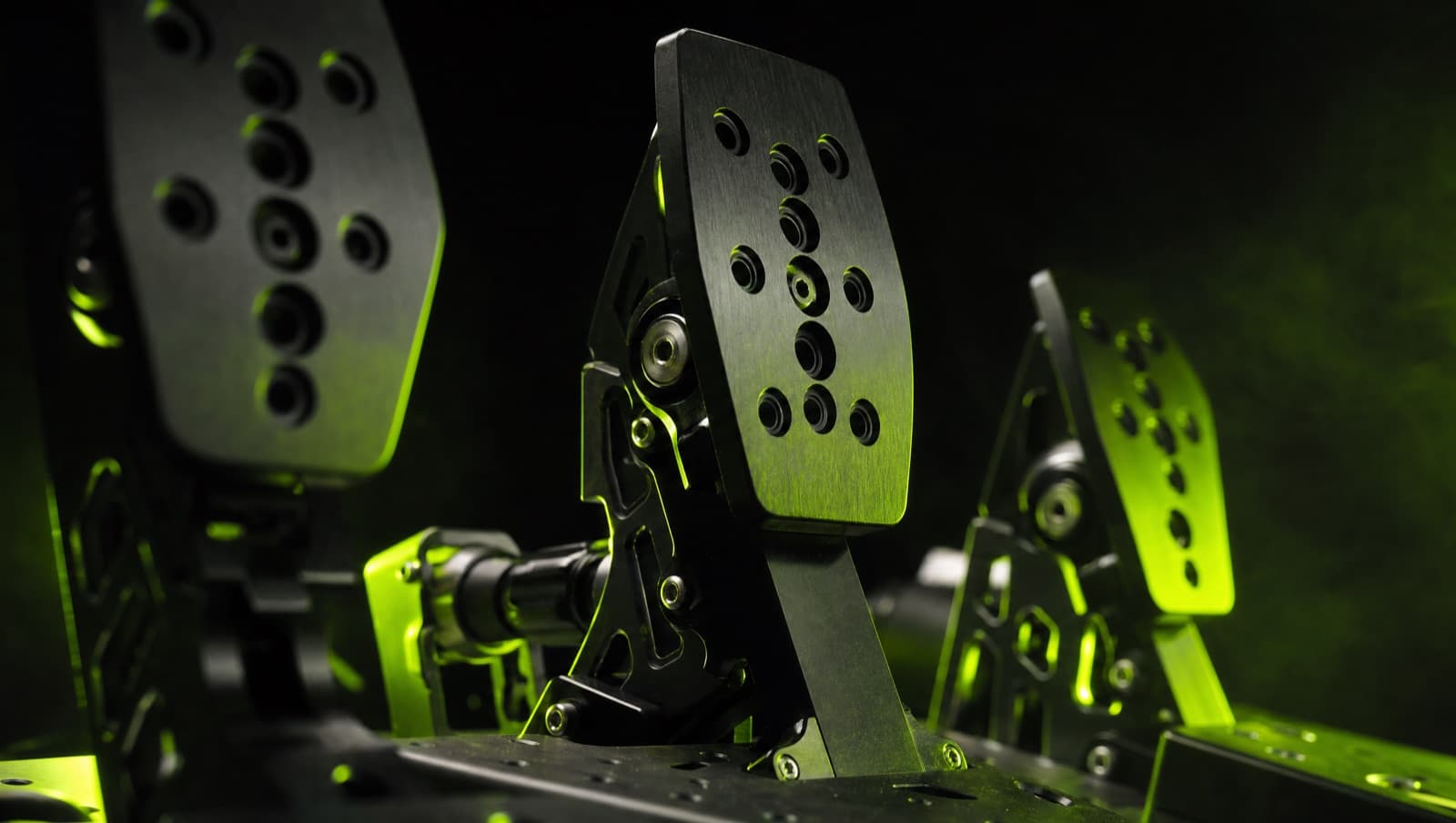
Ask any coach where a beginner should spend first, and most will say pedals — not the wheel. The reason is braking consistency, and that comes down to how the brake pedal senses your input.
TL;DR — the 30-second answer
The three sensing technologies, explained
Every pedal has to answer one question: how does it know what your foot is doing? There are three answers, and they are not equal:
| Technology | Measures | Consistency | Durability | Best for |
|---|---|---|---|---|
| Potentiometer | Position (travel) | Drifts as it wears | Wears out — it's a contact part | Entry sets only |
| Hall-effect | Position (magnetic, contactless) | Good | Excellent — no contact, no wear | Throttle & clutch |
| Load cell | Pressure (kg of force) | Excellent — muscle memory locks in | Excellent | The brake. Period. |
Why pressure beats position for braking
Real car brakes respond to how hard you press, not how far the pedal travels. But the deeper reason load cells win is biomechanical: your leg is dramatically better at reproducing a force than a distance.
Ask a driver to push a pedal exactly 43 millimetres and they'll miss it constantly. Ask them to push at 60% of their maximum force and they'll nail it lap after lap — that's how muscle memory works. A load-cell brake taps into that, which is why braking consistency improves within days of switching.
Consistent braking means hitting the same brake point, at the same pressure, with the same release — every lap. That repeatability is worth more lap time than any wheel-side upgrade at the same price.
Step 1 — Pick your load rating
Load ratings describe the maximum force the brake reads. Higher isn't automatically better — it changes how firm the pedal feels:
| Rating | Pedal feel | Who it's for |
|---|---|---|
| 75–100 kg | Firm but comfortable in socks or trainers | Most drivers, desk & rig setups |
| 120–150 kg | Properly firm — braced seating recommended | Rig owners, aggressive braking styles |
| 200 kg | Race-car firm — needs a rigid rig and racing shoes to enjoy | Competition drivers, maximum modulation |
Step 2 — Check mounting and adjustability
A load cell is only as consistent as its foundation. Before buying, verify:
- 01Stiff baseplate or rig mounting — pedal flex destroys the pressure signal you just paid for. Hard-mount to a rig where possible; on carpet, a heavy baseplate with heel rest is the minimum.
- 02Adjustable stiffness (elastomers or springs) — your ideal brake firmness will change as your technique matures. Swappable elastomers let the pedal grow with you.
- 03Adjustable pedal faces and spacing — matching the pedal layout to your real driving position pays off in every session.
- 04Software curves — being able to shape the pressure curve (and set a deadzone) per sim is the difference between good and great pedals.
The upgrade-order rule
When hall-effect is still the right call
None of this makes hall-effect bad — it's the correct technology for throttle and clutch, where you're controlling position, not pressure. That's why well-designed sets combine a load-cell brake with hall-effect throttle and clutch: each axis gets the sensor that matches how your body actually uses it.
Frequently asked
Are load cell pedals worth it?+
For the brake, absolutely. Pressure-based braking is the most consistent way to hit your brake points, and consistency is what lowers lap times.
What load cell rating do I need?+
75–100 kg suits most players. Choose 180–200 kg only if you want maximum modulation and a very firm, race-car-like brake.
Recommended products
Ready to build your setup?
Shop the full lineup or grab a pre-matched bundle and skip the guesswork.